|
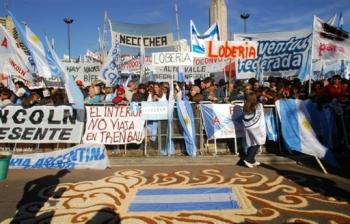
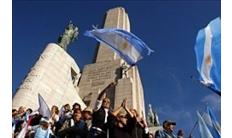
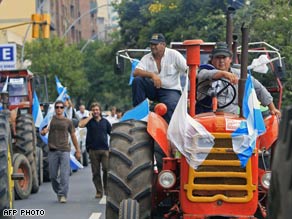
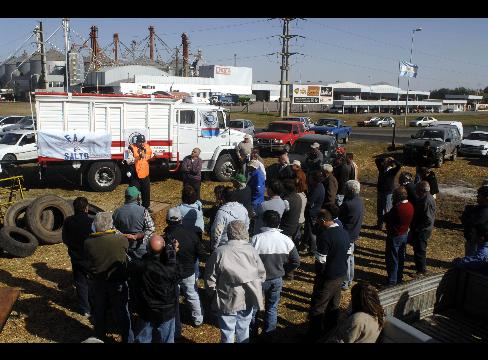
Argentine Farmers Protest Strike We are closely watching this issue, and so have decided to group all the articles in a special section to make it easy to follow. |
||||||||
|
|
||||||||
| Argentina
Plans Squeeze on Dissident Farmers
March 3, 2009 -- Argentina is preparing plans to broaden state intervention in agrarian markets, trying to tighten the screws on dissident farmers who are already unhappy about high export taxes. Any increase in government control over Argentina's largest industry risks unleashing social unrest in the countryside and congressional opposition, analysts say. Farmers, hammered by falling prices and drought, will meet Tuesday with government negotiators to discuss their grievances over agrarian policy. Since the two sides' first meeting last week, Argentina has been convulsed with rumors about new farm policy. One scenario involves creating a state-controlled entity that would compete with private grain-exporting companies. The idea is to help regulate prices and ensure a supply of farm goods in the domestic market. President Cristina Kirchner proved she won't shrink from bold steps to extend the government's economic reach when she nationalized privately held pension funds in October. But one factor likely limiting the scope of the government's options is increasing opposition in Congress, where the government bloc has been decimated by defections. Felipe Sola, a congressman and ex-governor who broke with the administration, accused Mrs. Kirchner of "making threats that don't scare anyone anymore." Farmers say the discussion of a greater state agrarian role is at least partly a tactic to get them to back away from their demands for an elimination of a 35% export tax on soybeans. Analysts also say the government is trying to prod farmers to sell the large cache of last year's soybean harvest that they still have stored in silos. By holding out for higher prices or lower taxes, farmers are depriving the government of tax revenue -- approaching $1 billion by some estimates -- that Mrs. Kirchner needs now to spend ahead of October's midterm elections. The talk of state intervention "shows that there are real cash-flow issues for the government," says Bernardo C. Piazzardi, an agribusiness specialist at Austral University in Rosario. In a legislative address Sunday, Mrs. Kirchner lashed out at farmers and promised the government would unveil "new instruments to intervene adequately in the economy." Under President Juan Domingo Peron, in the 1940s and 1950s, the government centralized marketing and exporting of farm goods in state hands. In recent years, agribusiness here has become sophisticated, with Argentina now the world's third-largest soybean producer, behind the U.S. and Brazil. |
||||||||
|
|
||||||||
| Argentina's
Inflation Probably Accelerated in July: Week Ahead
August 11, 2008 -- Argentine inflation probably accelerated in July as a four-month dispute with farmers over export taxes dragged on and the government allowed energy companies to raise rates for the first time since 2002. "The numbers we've been getting show that inflation is a growing problem,'' said Javier Salvucci, an economist at Silver Cloud Advisors in Buenos Aires. "Annual inflation is running at about 30 percent.'' Rising consumer prices threaten to further undermine President Cristina Fernandez de Kirchner after the government's confrontation with farm leaders led to food shortages and blocked roads, sending her public approval rating below 20 percent. The farm crisis ended July 18 when Fernandez rescinded her decree raising levies on exports of grains and oilseeds. Argentina announces July's inflation data at 3 p.m. New York time today. The government said consumer prices rose 9.3 percent in June from a year earlier. Economists and business leaders have questioned the official figures since January 2007, when Fernandez's husband and predecessor, Nestor Kirchner, began changing personnel at the national statistics agency. "There are doubts in every country about every system of measurement,'' Fernandez said Aug. 2 in her first press conference since taking office last December. She blamed media and business interests for helping fuel doubt about the data. Argentina will boost the country's minimum wage 27 percent to 1,240 pesos ($406) per month in two phases this year, Labor Minister Carlos Tomada said July 28. The government said electric utilities can raise rates as much as 30 percent, allowing the increase to be applied retroactively from July 1. Numbers 'a Joke' "The government's numbers are a joke,'' said Federico Thomsen, a political and economic analyst in Buenos Aires. "Unions don't rely on the government's data for wage negotiations and employers don't use it for counter-offers.'' Argentina's debt rating outlook may be cut from positive by Moody's Investors Service because the government's underreporting of inflation "raises serious questions about their willingness to pay,'' company analyst Gabriel Torres said Aug. 8. Rising prices are contributing to a slowdown in South America's second-largest economy. Construction activity fell 8.8 percent in June from May, the most in more than four years. At the same time, industrial production declined 4 percent, the statistics institute said July 23. Markets Last Week Last week, the yield on Argentina's benchmark 8.28 percent dollar bonds due in 2033 rose 121 basis points, or 1.21 percentage points, to 12.17 percent, according to Bloomberg data. The bond's price fell 8.1 cents on the dollar to 67.9 cents. The Buenos Aires benchmark Merval stock index fell 5.7 percent to 1776.66, its lowest in almost two years. Pampa Holding SA (PAMP AF), Argentina's biggest electricity holding company, fell 11.25 percent. Transener SA (TRAN AF), the operator of most of the country's high-tension power lines, fell 10.34 percent. |
||||||||
|
|
||||||||
| Hard Times for
Argentina
Latin America's most vulnerable economy faces restive farmers, skyrocketing inflation, and mounting debt. And it still needs to strike a deal with creditors it disappointed in 2001 August 6, 2008 -- A day's drive south of Buenos Aires in a town called Coronel Suarez, Facundo Gallardo grows corn and soybeans on land his family has tilled for half a century. With the high prices of global commodities, this should be the best of times in the world's biggest supplier of soy oil, second-largest producer of corn, and third-biggest shipper of soybeans. "Business would be great if I was anywhere but Argentina," Gallardo, 47, fumes. "Margins are shrinking all the time." Fertilizer prices have more than doubled over the past year and the price of diesel, while relatively cheap at 97% a gallon, has zoomed up by 30% to 50%. Worse, the President and her husband "hate us," Gallardo laments. President Cristina Fernndez de Kirchner, whose husband Nestor Kirchner ran the nation between 2003 and 2007, in March jacked up crop export taxes to raise government revenue and keep food prices down at home. The tax burden on farmers today exceeds 55%. The battle between the Fernndez de Kirchner administration and the farmers is only one reason why economists consider Argentina to be the most vulnerable economy in Latin America today. Concerns are rising that as the nation's economy slows, if Kirchner doesn't deal with mounting debt, rising inflation, sagging investment, and limited resources to pay for subsidies, then Argentina may be on the way to an economic crisis and debt default. Independent economists say annual inflation is 25% -- not the 9.3% the government claims. That would place Argentina just behind Venezuela in the region, with its 32% inflation rate. Economic growth is expected to slow to 6.5% this year and to just 2.5% in 2009. If Argentina is to have any hope of rolling over its debt or borrowing fresh money, it will have to reach some sort of agreement with creditors still demanding payment for around $20 billion in paper from a $93 billion sovereign debt default in 2001, the biggest in world history. A Long and Loud Rebellion The Kirchners -- Nestor is head of the ruling Peronist party -- touted the agriculture tax policy as key for assuring local food supplies, fighting inflation, and helping the poor. Fernndez de Kirchner is heavily reliant on farm tax revenue to finance surging government spending as labor unions -- a key base of her political support -- demand higher wages, and as energy shortages force her to import more diesel and natural gas. The latest tax increase -- to nearly 50% from 35% on soybeans, the country's biggest crop -- would have raised an additional $1.2 billion a year, which the President said would be used to build hospitals and schools. Enraged, farmers took to the streets. For more than four months they blocked highways, drove tractors through cities, withheld exports, and banged pots and pans to demand a reversal. It was the loudest -- and longest -- rebellion by Argentine farmers, a traditionally nonpolitical group whose predecessors helped make Argentina as prosperous as the U.S. in the late 1800s and early 1900s. The former President called them "coup mongers" and deployed Peronist sympathizers to break up demonstrations. After three months of failing to negotiate an end of hostilities, Fernndez de Kirchner asked congress to officially approve the taxes she had imposed by decree. On July 17, the senate voted no, with Vice-President Julio Cobos breaking a tie by voting against his boss. A Spending Problem It was an unexpected defeat for the President and has raised questions about her leadership and the financial health of the country. In an apparent effort to improve her battered image, the President held her first-ever news conference on Aug. 2 and defiantly insisted that taxing farm exports at a time of high world food prices is a legitimate "instrument of economic policy." The administration needed the export-tax revenue to cover rising debt costs and subsidies. "This is a government that doesn't stop spending and this is putting in danger its capacity to pay debt," says Francisco Mezzadri, an independent economist in Buenos Aires. The defeat came after five years of swelling popularity for the Kirchners. Law school sweethearts, they have followed a largely populist agenda of price controls, subsidies, and wage hikes, and tax cuts focused on the working class. This helped kick-start the economy after the 2001-02 economic crisis and 65% currency devaluation, with the country posting growth of more than 8% a year since 2003. "Old and Tired" Already? Officials bragged of Chinese growth rates that helped poverty levels shrink from 50% of the population to just 20%. Booming agricultural exports helped fiscal and trade accounts swing to surpluses, and international reserves bulged to $50 billion. Yet holes began to appear in the model, from energy scarcities to declining investment. The government fiddled with inflation statistics and relied heavily on price controls and subsidies to try to keep a lid on escalating prices. The fiscal and trade surpluses are narrowing on rising energy imports. Subsidies are expected to nearly double this year, to $6 billion. "The government looks old and tired after only eight months" in office, says Federico Thomsen, an economic consultant in Buenos Aires. The President's approval rating dropped to 20%; when she took office in December, her ratings were 56%, thanks in large part to her husband's legacy of high growth. Defaulted Debt Another problem plaguing Argentina's economic advance is the hangover still remaining from the 2001 default, which cut the country's access to international financial markets. The Paris Club, a group of the world's 19 richest nations, is seeking repayment of $6.3 billion. And holders of more than $20 billion of bonds, who refused to accept a 70% haircut in a 2005 restructuring of part of the defaulted debt, are suing for full repayment. The President has "let a golden opportunity slip by" by failing to sort out the delinquent debt, says Robert Shapiro, co-chairman of Washington [D.C.]-based lobbying group American Task Force Argentina, which represents 39 debtors with defaulted bonds. "It would have been easier to resolve this when times were good." Argentina can only raise capital domestically and from Venezuela, which charges interest rates of up to 13%. At first, this wasn't a problem. Revenue was spilling in from export duties as commodities prices surged, limiting the need for short-term financing. But the overturn of the higher export taxes means less revenue will flow in even as government spending and debt levels are rising -- debt is now at 56% of GDP, or 67% including the debt owed to the haircut holdouts, compared with 54% in 2001. Most independent economists don't foresee debt payment problems this year or next. But to cover the defaulted debt -- the President has hinted she is willing to resolve the Paris Club debt -- the government would have to tap central bank reserves, as it did when it paid off its $9.5 billion debt with the International Monetary Fund in 2005. "Serious Consequences?" With Kirchner's popularity and political support waning, that may be difficult. "It will require real character and leadership," says Shapiro. If it does repay its remaining creditors, Argentina could slowly rebuild credibility, helping reduce capital flight and encourage investors to return to the country. In May, the central bank sold nearly $3 billion in dollars to discourage savers from dumping pesos during the farm conflict. "This is not rocket science. It is basic economics," Shapiro says. But the defaulted debt is not going to go away and this is worrying, he says. If Argentina falls into another crisis, a default on current debt on top of the outstanding problems will bring "serious consequences." |
||||||||
|
|
||||||||
| Argentina's
government-farmer stand-off heats up as Congress approves new tax news July 7, 2008 -- The stand-off between the Argentine government and the country's farmers, which had been in a temporary lull after the latter called off a three-month protesting a new tax regime, seems all set to reignite with the lower house of the legislature approving the measure on Saturday. (See: Argentine farmers' ease 3-month strike as protesters agree to meet President) Argentina is among the world's biggest food producers - it is the world's third-largest exporter of soy and wheat and the second-biggest exporter of corn. Argentine President Cristina Fernandez, wife of former President of Argentina Néstor Kirchner and the first wife in history to be elected to succeed her husband as a president, had implemented a more than 10-per cent increase in the taxes on 11 March, sparking months of on-and-off protests by major farm groups who blocked highways and caused nationwide food shortages. Even government supporters protested, urging Fernandez to negotiate an end to the crisis, that has led to her popularity plummeting. The 103-day farmers' strike was called off on 22 June after the president invited the demonstrators for talks and promised to place the new tax measures in front of the nation's Congress. However, detractors derided the move as a sham, as the president's political party, the Peronists, hold a majority. Therefore, Saturday's 129-122 vote may come as somewhat as an embarrassment for the beleaguered president, even though it crossed the majority mark of 125. Some members of her party, especially from rural areas, and her allied Front for Victory party openly opposed the tax increases, revealing fissures in a traditionally solid political front. To build support for the bill, the government says it has expanded tax exemptions and rebates for small- and medium-sized agricultural producers. But farmers say the tax rates are still too high and demand the sliding-scale system be suspended. Farm leaders "reject what the ruling party has presented," said Eduardo Buzzi, president of the Argentine Agrarian Federation. "It leaves farmers in the same situation they've been in for the last 120 days." The bill is scheduled to be taken up for debate by the upper legislative house, the Senate, in the next few days. "We're still playing in the first half,'' Buzzi said, ''In the second half, we're going to play in the senate and we'll go to the courts, even to the supreme court,'' to stop the new taxes. Fernandez has refused to roll back the taxes, saying they are needed to share soaring farm profits with Argentina's 10 million poor. Farmers contend the higher taxes make it hard for them to make a living and that they need to reinvest profits to increase production to meet rising demand. In the October 2007 general election, Fernández, who ran for the presidency of Argentina, representing the ruling Front for Victory party, won a 45.29 per cent of the vote, beating her nearest rival a 22% lead over her nearest rival. This was one of the widest margins obtained by a candidate since democracy returned in 1983. |
||||||||
|
|
||||||||
| Bulker backlog amid
Argentina farmers' strike
June 18, 2008 -- NEARLY 100 panamax bulkers are waiting at the mouth of the River Plate due to uncertainty regarding the loading of grain cargoes in Argentine ports. However, one Oslo broker told Lloyd’s List that he thought 100 vessels waiting outside the River Plate sounded “excessive”, and “thought more like 40 or 50”. |
||||||||
|
|
||||||||
Argentine Leader
Demands End to Farmers' Strike
June 18, 2008 -- President Cristina Fernandez told thousands of supporters Wednesday that a three-month strike against grain export-tax hikes was undemocratic and demanded that farmers lift road blockades that have caused food shortages across Argentina. The massive rally in a Buenos Aires' Plaza de Mayo was seen as a show of force by Fernandez in response to anti-government protests fueled by the bitter standoff with Argentina's farmers. "In the name of democracy, free up the highways, let Argentines get back to work," Fernandez told supporters who filled the plaza, many waving blue and white Argentine flags. The leaders of Argentina's four main farmers' groups said Wednesday night that they would continue the strike for two more days. Eduardo Buzzi, head of the Argentine Agrarian Federation, told a news conference that grain exports would remain suspended and trucks carrying grains would be blocked on highways through Friday at midnight. Perishable food products and meat will be allowed to pass. Members of four major farming groups have waged a three-month standoff with the center-left government since Fernandez decreed the tax increases on grain exports, suspending soy, wheat and corn exports and blocking highways. The blockades have emptied supermarket shelves of food and caused rural economies to flounder in a country that is one of the world's leading exporters of soy beans and corn. Fernandez says the export tax increases are needed to share soaring farm profits with Argentina's 10 million poor. Farmers contend the higher taxes make it hard for them to make a living and that they need to reinvest profits to increase production to meet rising demand. At Wednesday's rally, Fernandez said farm leaders wield too much political power even though "no one voted for them" in national elections. She said the protests were "interfering with democracy." Buzzi countered that farm protesters are "not destabilizers" and are not trying to overthrow the government. The president's speech came a day after she announced she was sending a bill to Argentina's two houses of Congress to debate the taxes, which she first implemented by presidential decree on March 11. Fernandez's Peronist party has a majority in both houses. Congressional debate has been one of the farmers' key demands, but they claimed Wednesday night the president only wants a rubber stamp from lawmakers. "We value the democratic gesture of sending the matter to Congress," Buzzi said. "But we do not agree with the project as it was sent to Congress," he said, since the bill only allows for the ratification of the contentious export tax increase. Rural leaders will meet with Argentine lawmakers this weekend in attempt to open up to the bill to debate. Buzzi called for a meeting with Fernandez the following week. On Monday, tens of thousands of Argentines took to the streets banging pots and pans and honking car horns, calling on the government to resume negotiations with the farmers. |
||||||||
|
|
||||||||
| Heritage Foundation:
The Argentina Farmers’ Strike
June 13, 2008 -- Argentina’s farmers are on strike. Again. Food isn’t being exported. It’s not even making it into city markets. It’s quite a comedown for what was one of the world’s wealthiest countries 100 years ago. Argentina’s economic glory days are long gone, thanks to the dysfunctional economic policies of Gen. Juan Domingo Peron and his political progeny, who have clung to power in Argentina more or less continuously since the 1940s. To understand what’s happened in Argentina, let’s recall the old cow-based definitions of political economies: Socialism: You have two cows. The State takes one and gives it to someone else. Communism: You have two cows. The State takes both and gives you the milk. Fascism: You have two cows. The State takes both and sells you the milk. In Argentina today, the situation looks like this: You have two cows. The Peronists take the milk, export it for record-high world prices, pay off their political cronies, subsidize their urban-poor political base and give the farmers whatever is left. Unfortunately for the farmers, what’s left often isn’t enough to cover their costs. For three generations Argentina has labored under the Peronists’ simple, but economically destructive, political formula: Increase wasteful welfare-state handouts; build a swollen bureaucracy to redistribute wealth; protect powerful, closed-shop trade unions from foreign competition; and generously lubricate all these components with corruption. Anyone raising serious objections risks a visit from political thugs. Of course, these policies have exacted a terrible toll: Some families in Argentine barrios have been unemployed and on welfare for three generations. Since coming to power in 2003, the presidential tag-team couple of Néstor Kirchner and Cristina Fernandez de Kirchner have financed their Peronist policies by exploiting high commodity prices. They’ve kept the peso artificially low and taxed agricultural exports heavily. It hasn’t worked. During his presidency from 2003 to 2007, Néstor Kirchner tried to stimulate growth by boosting government spending, wages and pensions. Predictably, inflation skyrocketed. Rather than move to correct the problems, The Economist notes, the Kirchners simply "whitewashed the effects of inflation" by canceling publication of official poverty statistics. They got a temporary reprieve from reality when Venezuelan President Hugo Chávez, their ideological soul mate, paid off much of a large chunk of Argentina’s $5 billion-plus official debt. Though Néstor Kirchner turned over the reins to his wife last year, his heavy hand remains visible. Most of her ministers are holdovers. The Economist Intelligence Unit observes that Cristina Kirchner has continued her husband’s "commitment to a weak currency policy … and to the heterodox measures, such as price caps, cross-subsidies and export taxes, which have been used to contain the resultant acceleration of inflation." But Argentina’s farmers no longer are willing to serve as the Kirchners' cash cow. When Cristina Kirchner’s finance minister raised taxes on agricultural exports to 44 percent earlier this year, they said "basta," meaning "enough." A 21-day strike ensued. Farmers blocked food shipments and demonstrated peacefully. The Kirchner government responded with occasional police brutality and deployed the Peronists' favorite populist weapon — rent-a-mobs. Ultimately, both sides agreed to a 30-day truce. It ended May 2, the Kirchners stubbornly refusing to negotiate a lower tax rate. With no settlement in sight, the farmers resumed their strike on May 7. Talks with the government since then have gone nowhere. With matters at an impasse, Argentine farm groups have suspended grain exports and meat sales. Thousands of U.S. teachers, farmers and other pension fund investors lost $3 billion when Argentina defaulted. Even though the Kirchners are currently sitting on more than $50 billion in hard currency reserves, they refuse to repay this debt in full. A solution won’t be easy, in large part because the country’s problems are so structural. The 2008 Index of Economic Freedom reports low scores for Argentina on property rights, labor freedom, freedom from corruption and, especially, financial freedom, stemming from the still-unresolved 2001-2002 crisis when Argentina defaulted on its foreign debt. Political interference with an inefficient judiciary makes investors mistrust Argentine courts. On the other hand, Chile has shown an openness to foreign investment, and officials there have been trying to fight corruption and protect property rights. While the Kirchners try to revive Juan Peron’s disastrous 1960s-era protectionist "import substitution" policies, Chileans lead South America in seeking free-trade agreements. They see the value of globalization and aren’t afraid of it. Even leftist Brazilian President Luiz Inacio Lula da Silva is doing a better job of governing than the Kirchners. He calls inflation a "degrading disease," advocates fiscal restraint and supports Brazil’s central bank anti-inflation measures. As a result, foreign investors are flocking to Brazil and shunning Argentina. Instead of perpetuating wasteful welfare state handouts and redistributing income, the Argentine government should look west and emulate the success that Chile has enjoyed from a combination of economic reform, privatization and limited government. Until it does, Argentina’s glory days will remain little more than a faded memory. |
||||||||
|
|
||||||||
| Argentine Truckers
Block Roads Over Farm Strike
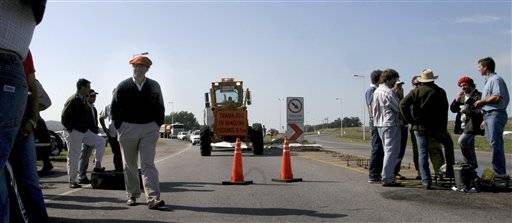
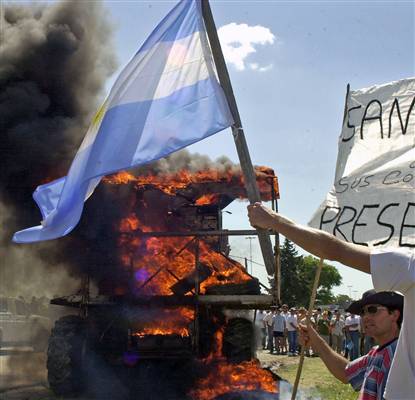
June 4, 2008 -- Hundreds of Argentine truckers blocked rural roadways on Wednesday to demand an end to a nearly three-month-long, bitter standoff between the farm sector and the government. Farmers are staging their third protest since March, when the government unveiled a new sliding-scale tax system for grain and oilseed exports. They are withholding grains from market to protest the change, which hiked levies on soy, the country's top crop. The transportation of farm goods has been halted intermittently, and some truckers fed up with the stalemate began blocking all traffic to press for a solution. "We've put up with this stoically for 87 days, watching how all other transport came and went, and we were the only ones at a standstill," Pablo Trapani, a member of the Cordoba Federation of Automotive Freight Transport, told local radio. During their first strike, farmers also manned roadblocks, causing some food shortages in Buenos Aires and other urban centers. They later shifted tactics to avoid alienating city dwellers, while still causing problems for President Cristina Fernandez's center-left government. Television images showed dozens of trucks parked alongside highways while drivers stopped traffic. These roadblocks "not only do not help the farm conflict, they complicate and slow things up," Eduardo Buzzi, president of the Argentine Agrarian Federation (FAA), told local radio. The FAA is one of four farm groups leading protests. "If there's something that we didn't want to have happen, it was that the cities be harmed," Buzzi was quoted as saying by local news agency DyN. The government has refused to negotiate with farmers as long as they continue striking. On Wednesday, some farmers and ranchers demonstrated alongside highways and spontaneously blocked roads, mainly to keep trucks carrying food from passing. In Entre Rios province, hundreds of people showed their support for farmers by waving small blue-and-white Argentine flags as tractors rumbled past the municipal building in the town of Concordia.
They are angry over state intervention in grains and livestock markets
dating back to former President Nestor Kirchner's administration.
Fernandez succeeded Kirchner, her husband, as president last December.
Her government says higher grains export taxes can help tame food inflation and protect consumers, while allowing the government to promote the redistribution of wealth. Farmers say the tax rates are confiscatory. Farmers extended their current protest through the weekend, bolstering global soybean prices. Argentina is a leading world supplier of corn, soybeans, wheat and beef. |
||||||||
|
|
||||||||
| Argentine Government
Slams Farmers for Extending Strike
June 3, 2008 -- Government officials criticized Argentine farmers on Tuesday for extending their strike against grain export taxes another week, as global soy prices surged on the news. The sliding-scale tax scheme that hiked levies on soybeans, Argentina's top crop, has sparked protests since March and hurt the approval ratings for President Cristina Fernandez. Farmers announced late on Monday they would keep withholding grains for sale through the weekend, which sent Chicago Board of Trade soybean futures soaring on Tuesday on the prospect of more U.S. soy exports. Extending the strike "shows a kind of autism toward what society in general is thinking. It's unfortunate because it doesn't do anyone any good," Interior Minister Florencio Randazzo told local television.
Farmers decided to resume livestock sales, but there was little
activity on Tuesday at the main cattle market of Liniers in Buenos
Aires, traders said.
Argentina is one of the world's top suppliers of corn, soybeans, wheat and beef. Farmers launched protests in March after the government unveiled its sliding-scale export tax system that raised duties on soybean and sunseed products. Last week the government tweaked rates on soy and other exports that would apply if prices rose well above current levels, but farmers said this was not enough. Farm leaders from the country's four main rural groups said they aim to gather 1 million signatures to petition Congress to change the export tax system. The government maintains it will not negotiate under pressure. "The government has called for dialogue many times. The only party that has shifted positions is the government, not the farm sector, but we trust that at some point reason will prevail," local news agency DyN quoted Cabinet Chief Alberto Fernandez as saying.
Farmers are angry over state intervention in grains and livestock
markets dating back to former President Nestor Kirchner's
administration. Cristina Fernandez succeeded Kirchner, her husband, as
president last December.
Her government says higher grains export taxes can help tame food inflation and protect consumers, while allowing the government to promote redistribution of wealth. Farmers say the tax rates are confiscatory. "Everyone feels this is a historic opportunity to put their truth on the table. There's been mistreatment for many years and this is being expressed by farmers and ranchers of all kinds," Silvio Corti, a leading member of the Argentine Agrarian Federation, said in televised remarks. The conflict sparked the resignation of a former economy minister and sent Fernandez's approval ratings sinking. To sustain the Argentine peso , the central bank has sold around $2 billion worth of dollars on currency markets since March. |
||||||||
|
|
||||||||
| Argentina: Farmers
Revive Strike Over Export Tax
May 29, 2008 -- Farmers resumed their national strike after the government broke off talks over a controversial export tax. The tax led to a crippling strike in March that caused domestic food shortages. This time, the farmers are gathering along roadways and stopping trucks carrying grains for export. They also planned to suspend sending cattle to slaughterhouses starting on Thursday. Both measures are to continue until early next week. |
||||||||
|
|
||||||||
| Farmers Skeptical of
Argentine Government's Bid to End Strike
May 29, 2008 -- The Argentine government has blinked for the first time since a 79-day farmers strike began, announcing ceilings on progressive export taxes on grain and soya, but farmers scoffed at the measure. 'This is not a real change but only an announcement for the urban public,' Eduardo Buzzi, president of the Argentine Agrarian Federation, said of the measure announced Thursday by cabinet chief Alberto Fernandez. The head of the federation in Entre Rios province, Alfredo De Angeli, who led a three-week strike in March, called the tax ceiling window dressing. 'It is only more of what the government has said before,' he said. The strikes began in March when the government raised export taxes on soya from 35 to 44 per cent. That tax rate is not to be changed under the government's proposal Thursday. Instead, a tax ceiling is to be set, and a lowering of the tax rate would only come if world prices rise above the ceiling. The government of President Cristina Kirchner had broken off talks Monday with the farmers, and her Peronist party accused the strikers of being 'anti-democratic' and trying to bring down the government. Thursday ceiling was decided without consultations with the farmers. The farmers on Wednesday had taken up their strike for the third time since March, vowing to block the export of grain and beans, such as soya, until Monday. On Thursday, they also plan to stop the delivery of cattle to slaughterhouses through Monday. After years of meagre earnings, Argentina's farmers don't want the export duties to cut into their profits just as they have begun to see more money flowing in with higher world food prices. The halt to agricultural exports have proved expensive for the government because a large part of its income comes from export duties. |
||||||||
|
|
||||||||
Argentine Farmers to
Stop Selling Grain for Export
May 29, 2008 -- Argentine farmers announced that they would again stop selling grain for export from Wednesday through June 2 in a deepening row with the government over export taxes. Protest leader Mario Llambias announced the measure in a statement Tuesday read to reporters. The farmers, major exporters of grains and soybeans, have been on strike since May 8 but leaders called a "truce" last week to allow talks to go ahead with government negotiators. Most of Argentina's grain production is for export, and more disruption could affect supply to the strained world grain market, particularly in Asia. Other protest measures include farmers refusing to sell cattle for farmwork, and setting up protest camps in major cities during the same time period. The four main farm organizations announced the strike just hours after the Peronist party of President Cristina Kirchner issued a statement describing the protest as an "anti-democratic attack" with the thinly-veiled aim of toppling the government. The statement said the farmer protest tactics were reminiscent of protests just ahead of military coups in 1930, 1955 and 1976. The farmers are looking to "impose" their viewpoints "and not dialogue," the statement read. The government has said it would not revise the sliding-scale system that links taxes on grains to global prices, and talks with the farmers scheduled for Monday were canceled. On Sunday hundreds of thousands rallied in the industrial center of Rosario, the principal port for agricultural exports, in support of farmers protesting the export taxes. The conflict began in March with a strike after Kirchner raised export tariffs on soybean products from 33 to 44.1 percent. Soybeans are now dubbed "green gold" in Argentina for the sky-high prices they fetch on the world commodity market. Half of Argentina's 30 million hectares of farmland are now given over to the profitable crop, which represents an export income of 24 billion dollars (15 billion euros) a year. |
||||||||
|
|
||||||||
| Argentina's Farmers,
Government Hold Rival Protests
May 26, 2008 -- Hundreds of thousands rallied Sunday in the industrial center of Rosario, northwest of the capital Buenos Aires, in support of farmers protesting export taxes on lucrative soybean products.
The opposition-backed farmers staged the protest in Rosario, the
principal port for agricultural exports and Argentina's soy, two and a
half months after a bitter dispute erupted over export tariffs imposed
on soybean products. |
||||||||
|
|
||||||||
| Argentina Turns Against
President After Farmers' Strike
May 25, 2008 -- Argentina's first female President, Cristina Fernandez de Kirchner, is fighting to restore her tattered reputation after a 70-day rural strike saw her public image plummet to its lowest level. Only one in four Argentinians has a positive image of her, according to figures released last week by a leading polling group. Three months ago, her approval rating was more than 50 per cent. Elected last October with 45 per cent of the popular vote, Fernandez's popularity has sunk in recent months as a lock-out by farmers threatened food shortages and frozen farm exports. Argentina's powerful farm lobby initially went on strike in mid-March after the introduction of controversial new taxes on soya, wheat and other key agricultural products. Fernandez won a brief reprieve after the main farming associations agreed to re-enter negotiations but angry farmers are still planning to go ahead with a huge demonstration today in the port town of Rosario. Fernandez will be heading a rally of her own today to mark Argentina's National Day. Behind the customary flag-waving and confetti, she must be asking herself where it all went wrong. The economy, the usual weather vane of public content, is growing at more than 6 per cent a year thanks to rocketing commodity prices, but there are some worrying economic and political trends, including inflation. Government figures put price rises at 9 per cent a year, but private sector analysts say the government is massaging the numbers. Independent data suggests inflation could be three times higher. Fernandez's attempts to remedy the situation rest on fixing prices and reducing exports - much the same as her husband, ex-President Nestor Kirchner, while in power. Then, as now, prices show no sign of slowing. "Even if it has the political will to solve the inflation problem, it will still take a year or two," argues Alejandro Catterberg, director at polling firm Poliarquía. Price rises are feeding into fresh concerns over increasing inequality and poverty. Fernandez prefers to cite government figures that suggest a drop in the number of poor - albeit small - to eight million (20.6 per cent of the population). Figures from the church and other private groups, however, say a jump to 12 million is more realistic. The President's handling of the farmers' strike has also raised questions about her capacity to govern. From the outset of conflict, she shunned opportunities to sit down with the rural protesters. Instead, she branded the farmers as rural "oligarchs" and accused them of unpatriotically not sharing their profits. Her control within the ranks of power has also begun to look fragile. Three weeks ago, her economy minister Martín Lousteau resigned over the unpopular new tax scheme. Meanwhile, several supposedly pro-Kirchner provincial governors broke ranks by talking individually with the farming lobby. More grating for many Argentinians is the personal style of their 55-year-old head of state. Public opinion surveys increasingly portray her as arrogant, intolerant of opposing voices and conflictive. However, with a strong majority in Congress and a flailing political opposition, Fernandez has enough political clout to avoid such confrontations, argues Ricardo Rouvier, a political analyst. "Instead she continues to pursue a policy that quickly establishes groups as either friends or enemies." Her choice of government spokespeople merely exacerbates the combative nature of her administration. In Luis D'Elía and Guillermo Moreno, she has opted for two thuggish stalwarts of the pro-workers Peronist party. Harder to shrug off is her husband, Nestor Kirchner, who was president until December last year and is now head of the Peronist party. Credited with rescuing Argentina from its worst ever financial crash in 2001-2002, Kirchner continues to enjoy a positive image rating of around 50 per cent. A poll released last week suggests three in every 10 Argentinians believe it is the ex-president who is really calling the shots in the Presidential Palace - up from only one in 10 before the rural crisis. The changing fortunes of the economy also place the President in a very different political environment to her husband, who took over a country deep in debt, whereas Fernandez is sitting on federal reserves of more than $50 billion. As inflation creeps up, Argentinian consumers are feeling a "mismatch" between the booming economy and their decreasing personal spending power, according to Graciela Romer, a Buenos Aires-based political analyst. She said Argentinians were also looking for, in their first elected female head of state, a more sensitive, tolerant and conciliatory style of presidency. "These are not the characteristics that Cristina is showing," she said. |
||||||||
|
|
||||||||
| Argentine Farmers to
Suspend Strike
May 20, 2008 -- Argentine farmers announced plans Monday to suspend a 13-day strike and resume grain sales, paving the way for talks with the government to suspend contentious export restrictions. Farmers will resume shipments of wheat, soybeans, sunflower seeds and other grains beginning Wednesday at midnight (0300 GMT), said Mario Llambias, head of the Confederation of Rural Argentine producers. The coming truce promises another lull in an on-again, off-again battle between the government and farmers, who have bitterly protested increased export taxes for weeks. President Cristina Fernandez imposed the measure in mid-March, raising export duties on soybeans from 35 percent to as high as 45 percent. Similar increases were tacked onto other grains in a bid to boost the nation's tax revenue while world commodity prices are high. Argentina is the world's second-largest exporter of corn and third-largest of soy, according to the U.S. Department of Agriculture. Farm leaders on Monday said they expected talks to resume shortly with Fernandez's government, which had vowed not to negotiate until growers ended their ban on grain sales. "We hope the government won't disappoint us," protest leader Eduardo Buzzi said. The protest has deprived the government of increased tax income, but has not caused renewed food shortages, as many had feared. Farmers blockaded key highways for 21 days in March, causing stores in Buenos Aires and other cities to run low on staples like beef and vegetables. Fernandez called for unity in a conciliatory speech last week, but offered no specific proposal. Her office did not immediately react late Monday to news of the strike's suspension. Her government has refused to re-examine farmer's central demand that it roll back soybean export taxes and other restrictions. The farmbelt rebellion is the first large domestic crisis to confront Fernandez's five-month-old government and triggered the recent departure of her first economy minister. |
||||||||
|
|
||||||||
| Argentine
Farm Strike Means Lengthy Lunches for Grain Traders May 14, 2008 -- A nationwide strike by farmers in Argentina has left traders at the nation's biggest agricultural exchanges with little or nothing to do. Trading at the Buenos Aires Cereals Exchange and the Rosario Board of Trade has been at a near standstill since farmers began withholding crops and blocking grain trucks on May 7, the second protest since March against higher export taxes.
"It's so unpredictable that you don't know what to do next,'' said Cesar Gagliardo, president of Buenos Aires grains brokerage Artegran SA. "There's nothing else to do but to take long lunches.'' The wait may continue beyond May 15, when leaders of farm groups will meet to decide whether to extend their protests. A prolonged disruption in crop shipments may boost global grain prices and damage Argentina's earnings from exports, more than half of which come from agricultural products. Argentina is the world's third-largest soybean exporter and the biggest shipper of vegetable oil made from the crop. The South American country is the second-largest exporter of corn, and fourth in wheat. All those farm products have risen to records this year. Former economy minister Martin Lousteau introduced a variable export tax that levies soybeans and sunflower seeds at more than 40 percent, depending on prices, to replace a fixed tax rate of 35 percent. Lousteau resigned April 24 after the first strike caused food shortages, halted grain exports and provoked the biggest challenge to President Cristina Fernandez's five-month-old government. Farmers suspended protests for a month before restoring blockades after talks with the government collapsed. Trading Plunges In the empty trading hall of the exchange, which the MatBA shares with the Buenos Aires Cereals Exchange, prices for soymeal and other products written in chalk on blackboards near electronic wall monitors haven't been updated since May 6. Together, the exchanges trade about 45 million metric tons of cereals and oilseeds a year, almost half of the country's output. "Today people aren't selling their soybeans, because they don't know what will happen with the taxes,'' Luciano Miguens, head of the Rural Society, said during a meeting yesterday between farm-group leaders and opposition congressmen. Withholding Crops About 67 percent of the corn crop had been harvested as of May 8, and 82 percent of the soybeans had been collected, according to the Buenos Aires Cereals Exchange. Argentina's regional leaders stepped up efforts to bring farmers and the central government back to the negotiating table tomorrow, when the current strike is scheduled to end. "I hope a solution can be found quickly,'' said Hector Campana, the deputy governor of Cordoba, Argentina's main soybean-growing province. "This protest has already gone on too long and nobody is benefiting from it -- neither the farmers nor the government,'' he told reporters in Buenos Aires yesterday. On the Rosario Board of Trade, which accounts for another 40 percent of Argentina's grains business, no trade has taken place since May 8, said Lorena d'Angelo, an analyst at the exchange. "The operators aren't here, since the buyers aren't here,'' d'Angelo said in a telephone interview yesterday. "I don't think it's going back to normal this Thursday.'' Blocking Trucks Exporters, including Cargill Inc., the largest U.S. agricultural company, and Bunge Ltd., are using inventories at processing plants on the Parana River to meet deliveries to clients, said Alberto Rodriguez, president of the Argentine Vegetable Oil Chamber and Cereals Export Center, known as CIARA- CEC. Exporters also unload barges carrying soybeans from neighboring Paraguay, the world's fourth-largest exporter. "The situation for each exporter is different, depending on their storage capacities,'' Rodriguez said in a telephone interview yesterday. "But this situation is driving up freight costs, and that has us worried.'' Shipping Rates Shipbrokers are "still using caution'' sending vessels to be loaded with grains at ports on the Parana River, said Sinan Kurtul, a Scarsdale, New York-based broker at EKS International. Gagliardo said traders, who buy grains from farmers and sell them to companies such as Cargill and Bunge, are suffering along with sellers of agricultural equipment and other service providers as the strike continues. "People who make a living off of this commercial chain are paralyzed,'' Gagliardo said. "An urgent political decision is lacking to end this affair.'' |
||||||||
|
|
||||||||
| Argentine
Farmers to Extend Strike, Seek More Support
May 12, 2008 -- Striking Argentine farmers are seeking the support of provincial leaders and lawmakers in a protest against tax increases on grains and may prolong a disruption of agricultural exports. The governor of Cordoba, Argentina's biggest soybean- growing region, is scheduled to meet today with the farm groups that organized the eight-day strike. Opposition-party members of Congress pledged over the weekend to work toward repealing the new export tax as farmers rallied in cities across the country. Growers have prevented grain trucks from reaching ports since May 7, when talks with the government broke down. When the higher tax was announced in March, roadblocks that stopped nearly all traffic led to food shortages and provoked the biggest challenge to President Cristina's Fernandez de Kirchner's five-month-old government. "As a producer, I don't feel like sitting down for more negotiations,'' Ricardo Buryaile, vice president of the Argentine Rural Confederations, said yesterday in an interview on Radio 10. "The government knows what we need.'' There were no talks with the government over the weekend, Federico Etiennot, a spokesman for the Rural Society, said yesterday in a telephone interview. The Rural Society is Argentina's biggest farm group. Farm Protests Cordoba Governor Juan Schiaretti will meet with farm leaders at 3 p.m. (2 p.m. New York time), and Santa Fe Governor Hermes Binner will do the same on May 15, Etiennot said. Farm groups also will meet with congressmen from opposition parties tomorrow to officially reject the government's policies, according to a spokeswoman for Oscar Aguad, a congressional deputy for the main opposition party, the Radical Civil Union. Corn traded in Chicago has gained 68 percent in the past year and reached a record May 9. Wheat has advanced 67 percent and traded at an all-time high Feb. 27. Soybeans are up 81 percent from a year ago. Taxes, Inflation Argentina is the world's second-largest corn exporter and third in soybeans. About 67 percent of the corn crop had been harvested as of May 8, and 82 percent of the soybeans had been collected, according to the Buenos Aires Cereal Exchange. Senator Gerardo Morales of the Radical Civic Union party called on opposition leaders to meet tomorrow to discuss how to get the tax system repealed. The group will try to get 1 million signatures on a petition supporting their effort, Morales said May 10. A poll by Buenos Aires-based Felipe Noguera Consultores found that 78 percent of Argentines want the government to change the export tax system and 14 percent prefer that the levies remain as they are, La Nacion said May 10. The telephone survey of 1,030 Argentines, taken during the last week of April, has a margin of error of 3 percentage points, La Nacion said. Argentina Inflation "We aren't the ones responsible for inflation,'' Eduardo Buzzi, president of the Argentine Agrarian Federation, said at a rally May 10 in Entre Rios province. ``They were getting plenty from us when the taxes were 35 percent.'' Export-tax revenue, including duties on agricultural goods and fuels, more than doubled to 1.5 billion pesos ($472 million) in April from a year earlier, the government reported on May 5. Argentine Vice President Julio Cobos said yesterday that farmers should return to negotiations ``without conditions over deadlines and issues,'' online newspaper Infobae.com reported. Alfredo Coutino, a Latin America economist at Moody's Economy.com, said May 8 that the protests and export disruptions may shave 1 percentage point off economic growth this year. Trucks Blocked Only nine trucks carrying grains for export arrived at ports on the Parana River by 6 a.m. this morning, less than 1 percent of the number on the same day a year earlier, the Rosario Board of Trade said on its Web site today. "You've asked us not to weaken,'' Buzzi told farmers gathered in Entre Rios province over the weekend. "And we're asking the same of you: Don't let up.'' |
||||||||
|
|
||||||||
| Argentine Farmers
Strike Again
May 8, 2008 -- Thousands of Argentine farmers went on strike today over tax increases on food exports. Protesting farmers have withheld crops and blocked
the progress of trucks as the end came to a 30-day truce created after a previous strike. That stoppage lasted three weeks and led to food shortages throughout Argentina. Government officials have equated the farmers’ actions with "extortion" and called the strike “irresponsible.” Rural leader Alfredo De Angeli disagreed: "We want to seriously negotiate and not to be teased or told one thing and then take that back," he said. "The only thing (the government) does is fool the people, yet the people believe in us and ask that we do not weaken our position." |
||||||||
|
|
||||||||
Argentine
Farmers Block Grain Trucks, Withhold Crops
May 8, 2008 -- Argentine farmers began their second national strike in as many months by blocking grain exports and withholding crops to protest tax increases and price caps on domestic food. An eight-day strike was called yesterday after government talks collapsed, and farmers began to stop trucks on highways across the country last night. Alfredo De Angeli, a farmer who was among the leaders of a three-week protest in March, urged President Cristina Fernandez de Kirchner to intervene. "We're not going to back down,'' De Angeli told protesters at a rally held on a highway linking Argentina with Brazil. "If the president wants us to be here more days, we will be here,'' De Angeli said in comments broadcast on local television. The protests threaten to deepen a global food shortage and hurt South America's second-biggest economy. Argentina, the world's second-largest corn exporter and No. 3 in soybeans, relies on agriculture for more than half of its export earnings. The government imposed the export taxes and food-price caps to combat domestic inflation. 'Extortion' Pablo Moyano, the head of Argentina's truck drivers union, said his members won't let farmers selectively block the roads. "Everyone passes or no one passes,'' Moyano told state-run newswire Telam last night. Ariel Onguino, 46, vice president of El Aguilucho SA, a truck company based in Rosario, said revenue has fallen 40 percent since March and he may lay off some of the company's 250 employees. The strike is "irresponsible,'' Argentina's Interior Minister Florencio Randazzo said in comments made to Radio Mitre. "All they want to do is defend their own interest instead of thinking of the general public,'' he said. Cronica Television channel showed farmers taking dozens of tractors and trucks to downtown Mar del Plata city in Buenos Aires province to protest. Some demonstrators held signs saying: "They are lying to you, farmers are on your side.'' Missed Opportunity "The way this affair has been handled by the government, along with high inflation, should continue to weigh negatively on the government's popularity,'' Bertrand Delgado, a Latin America economist for IDEAglobal, a New York-based research firm, said in an e-mailed note yesterday. Public approval of Fernandez's performance dropped to 29 percent from 35 percent in March, Buenos Aires-based polling company Graciela Romer & Associates said May 6. The government blames accelerating inflation on the farmers' strike that emptied supermarket shelves before ending April 2, said Sergio Berensztein, a Buenos Aires political analyst at pollster Poliarquia Consultores. Inflation Accelerates "There was no agreement because one side of the table wasn't interested in reaching an accord,'' Berensztein said. "The government is far more comfortable with confrontation and creating an enemy in the eyes of the people.'' The risk of owning Argentine bonds neared the highest since June 22, 2005, according to Bloomberg data. Five-year credit default swaps based on the country's debt increased 8 basis points to 6.20 percentage points. That means it costs $620,000 to protect $10 million of the country's debt from default. Credit-default swaps, contracts conceived to protect bondholders against default, pay the buyer face value in exchange for the underlying securities or the cash equivalent should a borrower fail to adhere to its debt agreements. Bonds, Stocks Argentina's Merval index fell 0.5 percent to 2,084.54 after losing 1.6 percent yesterday. Cresud SACIF y A, which rents Argentine farmland and raises cattle, fell 2 centavos, or 0.4 percent, to 5.10 pesos, following a 3 percent drop yesterday, the biggest loss since March 19. Farmers want the government to modify a variable export tax introduced almost two months ago. The tax levies soybeans and sunflower seeds at more than 40 percent, depending on prices, compared with a previous fixed rate of 35 percent. Export taxes, which include levies on agricultural goods as well as fuels, more than doubled to 1.5 billion pesos ($471 million) in April from a year earlier, the government reported May 5. Export taxes accounted for about 15 percent of government tax revenue last month. Growth Outlook "I don't think the strike is going to be over very soon and exports are an important part of economic growth in Argentina,'' Saddi said in a telephone interview. Economy Minister Martin Lousteau resigned April 24 as farmers protests caused food shortages and halted grain exports, prompting the biggest anti-government demonstrations since 2001. Soybean futures for July delivery rose 3 cents, or 0.2 percent, to $13.12 a bushel on the Chicago Board of Trade. The price has surged 80 percent in the past year. "Sounds to me like the Argentine government is still taking a hard line and that farmers are unlikely to be mollified,'' said Anne Frick, a senior oilseed analyst for Prudential Financial in New York. "The market's response is surprisingly tepid, in my view, given what looks to me like the increased likelihood of some export impediments.'' Withholding Supply "Farmers aren't selling grains under these authoritative measures, as this is almost confiscation,'' said Gagliardo, who sells crops to exporters such as Cargill Inc. and Bunge Ltd. "The countryside is full of plastic silo bags, and farmers are using old silos or disused barns to store their harvests.'' |
||||||||
|
|
||||||||
| Argentine
Dollar Bonds Decline as Farmers Plan to Renew Strike
May 7, 2008 -- Argentine bonds dropped the most in a week as farmers said they would undertake a new strike after failing to reach an accord over export taxes with the government. The yield on Argentina's benchmark 8.28 percent bond maturing in 2033 jumped 21 basis points, or 0.21 percentage point, to 10.51 percent at 4:05 p.m. in New York, according to composite data compiled by Bloomberg. The bond's price fell 1.65 cents on the dollar, the biggest decline since April 25, to 79.10 cents. Investors shed Argentine securities as farmers said they will set up blockades to disrupt exports after the government of Cristina Fernandez de Kirchner refused to scrap a tax increase. Farmers staged a three-week strike in March that triggered nationwide food shortages and added to an inflation pickup. "There's lots of uncertainty with Argentina right now,'' said Tomasz Stadnik, co-head of the $2.6 billion in emerging- market debt funds at ABN Amro Asset Management Services in London. "This is detrimental to both parties.'' The extra yield investors demand to own Argentine bonds rather than Treasuries swelled 22 basis points to 5.68 percentage points, according to JP Morgan Chase & Co.'s EMBI Plus index. The so-called spread is the biggest since April 29. The risk of owning Argentine bonds jumped the most since April 25, the day after Economy Minister Martin Lousteau resigned, according to Bloomberg data. Five-year credit default swaps based on the country's debt climbed 16 basis points to 6.10 percentage points. That means it costs $610,000 to protect $10 million of the country's debt from default. Brazil, Indonesia Bond Sales Overall, emerging-market bond yields over U.S. Treasuries widened 6 basis points, the most since in April 21, to 2.55 percentage points as losses in U.S. stocks prompted investors to shun higher-yielding securities. Brazil sold $500 million of its dollar-denominated bonds due in 2017, its first international issue since receiving an investment-grade credit rating from Standard & Poor's last week. The government issued the 6 percent bonds due in 2017, in a reopening of a previous sale, to yield 5.30 percent, or 1.40 percentage points over U.S. Treasuries. Indonesia plans to hire Credit Suisse Group, Deutsche Bank AG and Lehman Brothers Holdings Inc. as advisers to sell $1.5 billion of dollar-denominated debt in June, two people with knowledge of the plan said. Emerging-market countries have about $35 billion of debt left to issue before year-end, said Luis Costa, an emerging- market strategist at Commerzbank AG in London. |
||||||||
|
|
||||||||
| Venezuela
Bonds Gain on Speculation Government to Buy Back Debt
April 29, 2008 -- Venezuela's benchmark dollar bonds had their biggest gain in two weeks on speculation the government may use some proceeds from a debt sale to repurchase outstanding securities. The yield on Venezuela's benchmark 9 1/4 percent bonds maturing in 2027 fell 19 basis points, or 0.19 percentage point, to 10.22 percent at 4:25 p.m. in New York, according to JPMorgan Chase & Co. The bonds' price climbed 1.45 cents on the dollar, the most since April 10, to 91.85 cents. Venezuela sold $4 billion of bonds maturing in 2023 and 2028 to local investors last week. The government said it plans to use proceeds to refinance debt. "Investors began believing the government will be buying bonds back with the resources,'' said Gianfranco Bertozzi, an economist at Lehman Brothers Holdings Inc. in New York. "There might have been doubts before. They are serious about buying back bonds.'' The risk of owning Venezuelan bonds fell the most since Aug. 16, according to Bloomberg data. Five-year credit default swaps based on the country's debt declined 10 basis points to 617 basis points. That means it costs $617,000 to protect $10 million of the country's debt from default. The extra yield investors demand to own Venezuelan bonds rather than U.S. Treasuries narrowed 18 basis points, the most in emerging markets, to 6.20 percentage points. The so-called spread on emerging market debt shrank 2 basis points to 2.63 percentage points. Farmers' Strike Farmers have set a May 2 deadline to reach an accord with President Cristina Fernandez de Kirchner's government. Last month, farmers carried out a nationwide work stoppage for three weeks to protest an increase in export taxes, triggering food shortages and adding to a pickup in inflation. "The May 2 deadline the farmers have is quickly approaching, and it's unclear what the plan is on the part of the government,'' said Nick Chamie, head of emerging-market research at RBC Capital Markets in Toronto. "There's a vacuum of information coming out of Argentina. We're seeing continued downward pressure on asset values.'' |
||||||||
|
|
||||||||
In Argentina’s Grain
Belt, Farmers Revolt Over Taxes
April 27, 2008 -- When the government decided in March to raise taxes on farmers’ profits, it set off a rural revolt in Argentina. For three weeks enraged farmers blocked roads nationwide, paralyzing grain and meat sales and causing food shortages. Since then, the government has been trying to quell Argentina’s restive farmers at the negotiating table. But farmers like Marcelo and Pablo Marchetti, brothers in this country’s lush grain belt west of the capital, say the talks are going nowhere and are yet more proof that President Cristina Fernández de Kirchner, in office just four months, does not understand them. They are preparing to resume crippling strikes of grain exports once the deadline for the talks expires on Friday. Some farmers have already spontaneously put up roadblocks in recent days. “They don’t want to listen to us,” said Pablo Marchetti, 40, whose Italian great-grandfather founded this town of 1,500 a century ago. “In the short term, I just don’t see them finding a logical solution to this whole problem.” The farmers say they are concerned not only about profits, though the steeper taxes have cut into them. They also say Mrs. Kirchner’s policies are threatening to reverse one of the great agricultural booms in Argentina’s history and to snuff out a technological and entrepreneurial revolution that has made the country a leading food source in a world racked by hunger and rising food prices.
“We have an enormous historic opportunity to grow as a country, but the government wants to punish a sector that should continue to be an engine of growth,” said Marcelo Marchetti, 39. “The world has opened its doors to us, and here we are fighting among ourselves.” Tensions with the farmers exploded with unusual ferocity here, farmers say, in part because the new taxes touched a nerve in a nation where past governments used the farm sector to redistribute wealth to the poor. Mrs. Kirchner’s politics have stirred memories of Gen. Juan Domingo Perón, who in the early 1950s used profits from agricultural exports to industrialize the country and lift the poor. Trying to check inflation that independent economists put at close to 20 percent, Mrs. Kirchner, too, turned to farm profits and export controls, looking to increase subsidies for the poor and food supplies at home. Farmer discontent had been growing since at least 2006, when Néstor Kirchner, her husband and predecessor as president, limited beef exports to ensure a cheap supply at home. Once a dominant meat supplier, Argentina has watched as Brazil has passed it by, building the world’s largest beef export industry. Last year, even their tiny neighbor Uruguay exported more beef per capita than Argentina. Rural angst reached a boiling point in early March when the government increased export tariffs for the second time since October. The policies have also set de facto ceilings on prices. Mrs. Kirchner has criticized Argentine farmers as focusing too much on cash crops like soybeans at the expense of products needed for Argentine consumption, like dairy and meat. Soy exports have grown by 263 percent since 1997, to 11.5 million tons last year. She cast the farmers as greedy oligarchs in 4-by-4 vehicles, and as unpatriotic plotters intent on overthrowing the government.
Just days after the latest export measures took hold, the farmers mobilized. Using Web sites, cellphones and satellite dishes, they formed a communications network linking farms of all sizes in a joint stand against the government. Since both sides agreed to hold talks, the government has refused to back down on the export tariffs and has hardened its stance against the farmers. After promising in mid-April to lift a ban on beef exports, the government decided last week to keep it. It also canceled a meeting to discuss the wheat sector, making any chance of lifting a ban on those exports seem increasingly unlikely. And it threatened to impose sanctions on farmers if they failed to satisfy domestic demand. Press officers for the economy minister, who resigned Thursday, and for the interior commerce secretary did not respond to numerous requests for interviews made over the past two weeks. Miguel Nuñez, the president’s chief spokesman, also did not respond to interview requests. Daniel Kerner, an analyst with Eurasia Group, a consulting firm, said the rigidity of the government’s position is rooted in its need to “regain its political standing and avoid looking weak.” But opinion polls suggest Mrs. Kirchner’s uncompromising line on the farm revolt has damaged her popularity. She is making the political gamble that the farmers will not be able to mount strikes with the intensity and unity they managed before, analysts said. Polls have shown that voters, especially in the cities, will not tolerate food shortages or significant increases in food prices. But where Mrs. Kirchner’s government sees political survival, the Marchetti brothers see a potentially lost opportunity for the country to prosper from a historic boom in commodity prices.
Agriculture has a storied place in Argentine history. A surge in meat and grain exports in the 1880s helped the country’s leaders build the European-style city of Buenos Aires and briefly catapulted Argentina among the 10 richest countries in the world. Fifteen years ago, the Marchettis began farming here in Córdoba, the country’s second most important province for agriculture. Argentina was just opening to foreign investment, its currency pegged to the dollar, and it quickly became among the more competitive agricultural producers in the world. Today, with prices for soybeans, corn and wheat at or near record highs, “this was Argentina’s time to feed the world,” said Dan Basse, president of AgResource Company, an agricultural consultancy in Chicago. But the conflict over export taxes has bred uncertainty about Argentina, Mr. Basse said, and international grain companies have already signaled their preference to pour more money into neighboring Brazil, another agricultural juggernaut where farm policies have been clearer and more encouraging. Both are considered critical to global efforts to fill the soaring demand for soybeans in China and India. In Argentina’s sprawling rural provinces, the standoff has also sown seeds of doubt and weakened the Peronists. Governors have found themselves torn between supporting Mrs. Kirchner and their farm constituents. An emergency law passed in 2002, in the midst of an economic crisis, has allowed the Kirchner government to create export taxes and keep the revenues away from governors and mayors. The Kirchners have used the doling out of those revenues to maintain political control over the provinces, which were critical to Mrs. Kirchner’s election. But lately some governors have fought back, none more so than Juan Schiaretti, Córdoba’s governor and a Peronist, who won the election because of rural support. In a brief interview, Mr. Schiaretti confirmed that the farm conflict had created tensions between him and the national government. Mr. Schiaretti has pushed for more of what lawmakers call “co-participation” funds to ensure the provinces get a bigger share of farm revenues. Carlos Gutierrez, Córdoba’s agriculture minister, said that only 10 percent of the tariffs on soy flows back to the province for infrastructure and other projects; the rest stays in Buenos Aires with the national government. In Wenceslao Escalante, the Marchetti brothers, who both studied accounting in college, said the government’s policies were killing their incentives to produce more. A decade ago they formed their company, Cigra, investing in the latest seed technology and farm equipment, and later buying $400,000 grain harvesters with global positioning systems. Seven years ago the brothers expanded north into Chaco and Santiago del Estero, provinces where the land was thought to be too dry to support corn and soybeans. Today, with more advanced seeds and better crop rotation, it is considered the frontier for Argentine agriculture. But production there is threatened by declining profitability. As the government has taken more from the farmers, international prices for the supplies to produce their crops, including fertilizers and seeds, have been rising faster than the prices of the commodities, Marcelo Marchetti said. The price of phosphorus, for example, has nearly tripled since last year, he said. Suddenly the future seems cloudier. The brothers have decided not to make any investments over the next year. “Everything is on hold,” Mr. Marchetti said. |
||||||||
|
|
||||||||
Argentine Farm Talks
Stall as Deadline Nears
April 22, 2008 -- Argentine President Cristina Fernandez on Tuesday called for calm as talks with farm leaders grew more tense, raising expectations in financial markets that farmers might go back on strike. Argentina's farmers staged a three-week strike in March over a tax hike on soy exports, but suspended the protest on April 2 for 30 days in order to negotiate with Fernandez's center-left government. Farmers have complained of a lack of progress in the negotiations, but Fernandez said discussions should continue. "We should get back to common sense, responsibility (and) negotiation," she said in a televised speech at the presidential palace in Buenos Aires. As the end of the 30-day truce draws near, the only concrete development has been an agreement over beef prices and exports. However, that deal has already run into problems and fewer cattle were sent to the main Liniers market on Tuesday. "The talks are pretty difficult. The only area where we made a small advance was the beef issue, but today we're back to square one," Pablo Orsolini, vice president of the Argentine Agrarian Federation (FAA), told Reuters. "We're going to carry on negotiating until May 2. We're going to exhaust all avenues, but people are very annoyed and they're already thinking about taking some kind of measure from May 2," he added. The FAA was one of four agricultural associations that led the strike, which disrupted the country's key grains exports, emptied meat counters and landed Fernandez with her biggest crisis since she took office in December. UNCERTAINTY Argentine bonds, the peso currency and stocks took a beating on Tuesday due to the uncertainty over the farm talks, while soy futures at the Chicago Board of Trade closed up, partly on perceptions that the truce in Argentina could break. If farmers do renew their protest, it is not clear if they would resume the strike tactics seen last month when they halted sales of livestock and grains and manned roadblocks to stop farm goods reaching ports and supermarkets. Government officials and farm representatives discussed wheat policy on Tuesday and farm leaders said some progress had been made, with the talks set to continue on Wednesday. "We're looking for points in common ... that's positive," said Mario Llambias, president of the CRA association. The government has tightly controlled the wheat market in recent years as it seeks to tame rising prices for staples such as bread and pasta. Argentina is a top five wheat exporter, but the country's exports have repeatedly been restricted in recent years and no wheat export permits have been granted for months. As negotiations have stalled, farmers have criticized the government for involving Domestic Commerce Secretary Guillermo Moreno, who farmers accuse of using threats. Some political analysts say the government could be involving Moreno to pressure farmers to accept official proposals. "Both sides want a deal, but neither wants to give too much ground," said Roberto Bacman of the Center of Public Opinion Studies. |
||||||||
|
|
||||||||
Argentine
Farmers Suspend National Strike for 30 Days
April 2, 2008 -- Argentine farm groups, seeking to resume talks with the government over tax increases, suspended a three-week national strike that has caused food shortages and disrupted exports. The strike will be stopped for 30 days, Mario Llambias, president of the Argentine Rural Confederation, said today at a rally in Gualeguaychu, Argentina. Farmers will stay in a ``state of alert,'' he said. "We will keep fighting,'' Luciano Miguens, president of Argentina's Rural Society, the country's biggest farming group, said in a broadcast carried by Channel 26. "We need to speak to legislators and the judicial authority.'' Farmers went on strike March 12 after the government raised soybean export taxes to a variable rate of about 44 percent from a fixed rate of 35 percent. It was the biggest anti-government protest since the country's financial crisis of 2001, which led then-President Fernando de la Rua to quit. Argentina, which also boosted taxes on other agricultural commodities, is the world's second-largest corn exporter and the third-largest soybean producer. The strike caused food shortages in supermarkets and led grain exporters such as Bunge Ltd. to invoke a contractual provision called force majeure, which allows companies to cancel shipments without financial penalties because of events outside their control. Wheat Exports The halt in the strike means more food will make it to cities starting today, said Juan Echeverria, a leader of the Argentine Agrarian Federation. Hundreds of farmers waving Argentine flags congregated in a field outside the town of Gualeguaychu for the assembly today, images on Channel 26 showed. "Senators and legislators, here are the people you should be representing, here we are,'' Alfredo De Angelis of the Argentine Agrarian Federation shouted during the rally, which was broadcast live on national television. Fruit and vegetables already started arriving at Buenos Aires's Central Market earlier today after picket lines on major highways were lifted, Channel 26 showed. Beef supplies will return to normal in five days, Roberto Arancedo, president of the Liniers livestock market in Buenos Aires, told television channel C5N. The assembly follows a pro-government rally in Buenos Aires yesterday attended by President Cristina Fernandez de Kirchner and about 100,000 supporters. "Stop hurting Argentines and allow the trucks to travel,'' she said on a stage erected outside the presidential palace. |
||||||||
|
|
||||||||
| Argentine President
Calls for End to Farmers Strike
April 2, 2008 -- President Cristina Fernandez blasted striking farmers at a rally of 20,000 supporters Tuesday, comparing their nearly three-week-old protest to a 1976 strike that sowed chaos one month before a military coup. Seeking to build popular opposition to the strike against a disputed export tax increase, Fernandez urged farmers to immediately end hundreds of highway blockades. "Is it good that highways are cut so that food cannot be transported to market?" she said angrily, adding that such pressure tactics will not work in times of democracy. On the strike's 20th day Tuesday, farmers manned 300 road blockades, which for weeks have strangled the flow of farm goods to cities, emptying supermarket shelves, blocking key exports and causing the biggest crisis for Fernandez since she took office in December Small farmers are denouncing a March 11 presidential decree that raised export taxes on soybeans from 35 percent to as much as 45 percent and slapped new duties on other farm exports to attack inflation. On a stage outside the presidential palace, Fernandez told some 20,000 supporters including trade unionists, laborers and social and human rights activists that farmers imposed "food shortages" on Argentina in February 1976 — just before "our nation's worst tragedy." The subsequent coup launched a seven-year dictatorship. The president accused farmers of waging a media campaign to win over Argentine support. "Believe me, I've never seen so many attacks on the government in such a short time, so many insults," she said. The speech marked a return to tough talk, a day after her government offered concessions intended to benefit at least 62,000 small farmers, including transport subsidies, credits for dairy farmers and tax rebates for small soybean farmers. Farm groups said they would have no immediate statement on the speech, adding they would make an announcement on Wednesday — the date they say they will decide whether to extend the walkout. Alfredo De Angelis, a hardline strike leader in Entre Rios province, expressed anger over charges by the president that farmers were allied with the military in leading a chaotic rural strike in February 1976 just a month before the coup. "We are not coup plotters," he said angrily from a barricade northeast of the capital. Earlier Tuesday, Argentina's interior minister warned that the government is growing weary of the protests. "There's no reason for the countryside to still be on strike," Florencio Randazzo said. "We are not going to allow the shortages to continue." Nestor Barrera, a Tucuman municipal employee who drove past farm blockades in Argentina's heartland to the rally, said it was time to support Fernandez's center-left coalition. "A big soybean monopoly is behind this strike," he insisted. |
||||||||
|
|
||||||||
| Argentine Farmers Continue
Strike
Argentine farmers have said they will continue a crippling 19-day strike after rejecting a series of new government measures as insufficient. April 1, 2008 -- President Cristina Fernandez announced rebates on new export taxes for small- and medium-size farmers but refused to rescind a controversial tax rise. She asked farmers to "please" lift roadblocks that have caused shortages of products and blocked key exports. Farmers are furious over new export levies of up to 45% in some cases. Farmers said their strike would continue until Wednesday at least, but a leader of one of the country's biggest farm groups said dairy products would be allowed to go to market. No compromise With Economy Minister Martin Lousteau, she announced transport subsidies for farms that are far from markets, some tax rebates for small and medium-sized farms and credit plans for dairy farmers. But there was no compromise on the key sticking point of a new sliding scale of tax export taxes that would raise levies in some cases up to 45%. After her speech, the leaders of the four main striking farm groups said on television that the government's offer was insufficient but that they were open to further negotiations. The farmers briefly halted their action on Friday but resumed the blockades after talks failed to produce a breakthrough. Some growers working on small- to medium-sized farms say the taxes will reduce their income significantly and complain that they receive no state help. President Fernandez - who took office in December last year, succeeding her husband, Nestor - has said the taxes are a means to raise badly needed revenue, curb inflation and guarantee domestic supplies. She has refused to negotiate with the strikers until the farmers' strike is stopped. This is fast becoming the biggest crisis that she has faced since taking over the presidency, says the BBC's Daniel Schweimler in the capital, Buenos Aires. As well as causing meat and dairy shortages in the shops, the strike has hit exports and triggered clashes in Buenos Aires. Argentina, a leading exporter of beef, corn, soya oil and soybeans, has benefited from the recent global surge in commodity prices. |
||||||||
|
|
||||||||
| Argentina: Farmers
Strike Continues
April 1, 2008 -- Argentine farmer groups and the government of President Cristina Fernandez de Kirchner held six hours of talks on March 28 aimed at ending a 16-day-old producers' strike that had restricted food supplies in major cities. Strike supporters lifted some of the blockades they had maintained on highways throughout the country, but more radical sectors said this was only a 48-hour truce and stayed at their positions at highway entrances. The producers were protesting Fernandez de Kirchner's increase in taxes on soy, a major export crop for Argentina. The president, from the left wing of the populist Justicialist Party (PJ, Peronist), insisted that she would not give in to "extortion" from the producers. She noted that many of the strikers were very wealthy and contrasted their "protests of abundance" with the "protests of poverty" in the early 2000s when "thousands of Argentines [were] blocking streets and highways because they needed work," along with middle-class demonstrators who had lost their savings in the 2001 financial crisis. According to Argentine journalist Stella Calloni, the strike is led by the far-right Argentine Rural Society. Strike supporters held a protest in the Plaza de Mayo in Buenos Aires the evening of March 25. Stella says most of the 5,000 protesters beating on pots and pans were from the capital's richest neighborhoods. Some activists referred to the strike support actions as "fashion protests." The government has been backed by many activist groups, including the Mothers of the Plaza de Mayo, the Grandmothers of the Plaza de Mayo and the Federation of Argentine Workers (CTA). A Maoist and a Trotskyist group were backing the strike, although not its right-wing leadership. Many groups, including the Trotskyist Movement Toward Socialism (MST), rejected both the government and the strike. The National Picketer ("Piquetero") Bloc said: "[W]e working people and broad sectors of the middle class find ourselves like the salami in the sandwich in this conflict of the 'country' against the government... No one cares about the situation of the people." (La Jornada, Mexico, March 26, 27, 28, 29 from correspondent; Prensa de Frente, Argentina, March 28) |
||||||||
|
|
||||||||
| Argentina Farmers
Suspend Strike
March 28, 2008 -- Argentinian farmers have suspended a 16-day strike against higher taxes on grains exports and said they would begin talks with the government. The farm protests in Argentina had halted grain exports and led to food shortages in parts of the country, presenting Cristina Kirchner, the country's president, with her biggest crisis since taking office in December. "The objective is to facilitate a meeting with the national government, after which we will evaluate the results, which will be submitted to the rank and file nationwide," the four biggest farming groups said in a statement on Friday. Farm groups said they were responding to Kirchner's call the previous day, when she said the government would negotiate if the farmers ended their protest. Blocked Roads The protest, over a steep increase in taxes levied on soya beans, had been escalating, with demonstrations for and against the government and clashes between farmers and transporters angry about the blocked roads. The taxes, of up to 45 per cent, were imposed on a range of goods including soya beans, sunflower oil and beef in a bid to boost state revenue at a time of exceptionally high commodity prices and to curb high inflation in the country. Kirchner had labelled the farmers "extortionists", and said high commodities prices on the world market, coupled with Argentina's devalued peso, had made many rural landowners very wealthy. Some of the country's middle class, itself decimated in the a devastating financial collapse in 2001, sided with the farmers and held solidarity demonstrations in Buenos Aires. Kirchner's supporters - drawn from the large poor underclass - countered with their own marches and in some cases clashes erupted. On Thursday, she had struck a more conciliatory tone, pleading with farmers to end their strike. "The government's doors are open but please, lift this strike for the sake of the people," she said. |
||||||||
|
|
||||||||
|
Store Shelves Grow Bare as Argentine Farmers Continue Strike
March 27, 2008 -- As a strike by farmers continued for a 13th day Tuesday with no solution in sight, its impact was visible on meagerly stocked supermarket shelves in cities. Butchers and supermarkets were among the first hit. "We are looking for alternative suppliers because within 24 to 48 hours, we will have no more meat," said Miguel Calvete, who runs a Chinese supermarket in the capital. Hundreds of Argentines took to the streets of the capital, where they banged pots and pans in support of the striking growers, who are protesting an increase in export taxes for their products. One economist warned that the strike could result in more serious problems than short-term scarcity. "The most dangerous [scenario] is that there might also be problems of inflation with supply, which is a type of combustible that generates more inflation," said Jorge Colina. "The fewer products and goods available to place on the shelves, the more room for increasing prices." Argentine President Cristina Fernandez was unswayed, referring to the growers' demands as "extortion" and saying the increases on agricultural products are justified. "It is the sector that exports almost everything," she said. "About 95 percent of soybeans are exported. They're not exported in Argentine pesos, they're exported in euros, in dollars. But the costs are Argentine costs." The farmers' federations, for their part, announced that the strike will continue for an indeterminate period of time. "We thought this was going to generate a conciliatory discussion, but it has had the opposite effect," said Alfredo Rodes, executive director of the Confederation of Rural Associations of Buenos Aires and La Pampa. He said the taxes go directly to the central government, not to the provinces where the farmers live, and he accused the government of demanding "practically half" of farmers' production in taxes. His group, which organized roadblocks, posted where they would be on the Internet. But traffic jams still occurred, inconveniencing many people. "They have to try to resolve this as soon as possible," one woman said. "There are kids who are trying to get to school, and they're not arriving." |
||||||||
|
|
||||||||
| Argentina: Farmers' Strike
over Tax Increases Deepens
March 27, 2008 -- Striking farmers built new
highway blockades around Argentina's agricultural heartland Wednesday in
a standoff with the president over tax increases on major export crops. |
||||||||
|
|
||||||||
| Argentine Farmers Vow
to Press Strike Over Tax
March 27, 2008 -- Farmers in Argentina who have been on strike for two weeks to protest a tax increase on the export of grains said Wednesday that they would continue their protests until the government gave in. The strike has led to shortages of meat and dairy products, paralyzed local grain and livestock trade and forced major exporters of Argentine soy products to renege on some contracts. Thousands of people rallied nationwide on Tuesday evening in support of the farmers. The protesters banged on pots outside the presidential palace after the center-left president, Cristina Fernández de Kirchner, said she would not give in to “extortion.” Hector Boldrini, a farmer, said, “The government tried to put out the fire with gasoline.” “There’s no way we will cede ground,” he said at a roadside protest in Pergamino, in the fertile northern region of Buenos Aires Province. Elsewhere in Argentina, farmers blockaded highways to keep trucks from transporting agricultural goods. The government said it would clear the roads by force if necessary to get food to market. Several suppliers of Argentine soy and soy oil declared force majeure to back off from sending cargoes to China as a result of the protest, following a similar move on soy meal shipments to Europe, traders and industry officials said. The strike has slashed foreign currency inflows from agricultural exports, sending the local peso currency to its weakest level against the dollar in five months. Argentina has been one of the world’s main beneficiaries of a global surge in commodities prices. But farmers abhor government measures like export bans and price controls, which are being put into effect to stem inflation and to increase revenue. The farmers say they intend to continue the strike as long as necessary, demanding that the government repeal a new sliding-scale export tax regime that raises levies on soy and sunflower products at current prices. Ms. Kirchner has said the taxes help redistribute wealth in a country where nearly a quarter of people are poor. |
||||||||
|
|
||||||||
|
Argentine President Vows not to Give in to Farmers' Strike
March 26, 2008 -- Argentine President Cristina Fernandez vowed on Tuesday that the government would firmly rejected demands by farmers prolonging their days-long strike against an export tax hike. Pledging not to give in to extortion, the president said the government would negotiate, but the strike, which began March 13, should stop first. Facing the largest farm and ranch protest in decades and her most serious challenge since she took office, the president said in a speech that she understands agriculture's interests, but also wants farmers to know she is the president for all Argentine people. Argentine farmers, who are protesting against a government measure to increase soya export tax from 35 percent to 45 percent, have blocked roads with trucks and tractors and vowed to continue the strike as long as necessary. The tax hike is aimed at garnering more revenue for the government amid soaring soybean prices, but the farmers claim the government is robbing them of their money. The strike has forced the country to face a looming food shortage of farmed beef, dairy products, oil and grains. Argentina is one of the world's leading exporters of beef and soybeans. |
||||||||
|
|
||||||||
Argentine Farm Strike Tests
President
March 26, 2008 -- President Cristina Fernandez refused to ease tax hikes on agricultural exports Tuesday, facing down angry farmers embroiled in a nationwide strike that has all but halted production in one of the world's biggest beef-exporting nations. At least 9,000 cattle normally enter this capital's sprawling stockyard each day for slaughter, yet not a single animal arrived this week due to the farm and ranch strike, the largest in decades. South America's second-largest economy — a leading exporter of soybeans, beef and wheat — is in full farm belt rebellion over a new sliding-scale increase in export taxes. Soybean taxes are being hiked from 35 percent to 45 percent, with smaller increases on corn and other farm products. Scattered shops began emptying of beef, milk, chicken and cooking oil Tuesday as farm workers mounted the most serious challenge yet to Fernandez's fledgling government. "Bad policies by the government are leaving people without food, without beef," complained Mario Llambias, one of the farm protest organizers who announced Tuesday a 13-day old strike would now continue "indefinitely." But Fernandez appeared undeterred as she delivered a televised address later in the evening. Vowing not to "give in to extortion," the new president declared that her government will not grant any concessions to the striking farm and ranch workers. Fernandez said farm producers have profited from a boom in commodity prices and it is only fair to tax them more to redistribute wealth to poorer parts of society. "This seems like ... comedy," she said. Late Tuesday, thousands of angry middle-class residents of Buenos Aires and other cities responded to her speech by banging pots in a raucous, spontaneous outpouring of support for the farm workers. Strikers lit tires on fire after nightfall on blockaded roads and vowed to stiffen their protests. "Argentina! Argentina!" some 5,000 people, including mothers with strollers and others banging on pots joined a surging and unexpectedly strong challenge to the government. Other protesters in farm-dependent cities and hamlets across Argentina's farm belt waged similar pot-banging protests. "This is a pretty ugly wakeup alarm for the government after just a few months in power," said one angry protester Hector Bernardino, among the 5,000 who thronged the main Plaza de Mayo in Buenos Aires. He said middle class Argentines, like the farmers, are weary of taxes and double-digit inflation he said the government has sought to conceal behind praise for years of robust recovery. After a searing 2002 economic meltdown, the government replenished its coffers through taxes on surging grain exports and soaring commodity prices. The cash influx powered an economic growth rates topping 8 percent annually. Argentina's economy is back on track — and agriculture remains one of its most profitable sectors. It's only fair that farmers and ranchers be taxed on more of that wealth, according to Economy Minister Martin Lousteau, who announced the controversial tax overhaul on March 11. Growing demand for foodstuffs in China and other teeming nations, high oil prices and other shifts in the global economy have all helped pushed grain prices to new highs in recent months. But the agriculture industry is howling at having to pay more. The farmers are demanding to sit down and negotiate a rollback on the new taxes, which Buzzi calls "extortion" against farmers. The government says it won't start talks until the protests stop. And so the daily demonstrations have continued, with belching tractors and giant harvesters blocking rural highways nationwide, occasionally sowing monstrous traffic jams. During the long Easter holiday weekend on routes from the capital to South Atlantic beaches, many Argentines stuck in the traffic applauded the demonstrators, saying they too are fed up with government taxes. The protests have spread far beyond the capital, with sugarcane workers beating cane stalks along highways in north-central Tucuman province and soybean farmers dumping mounds of beans near the border with Uruguay. Police have managed to keep the most important routes open without wide scale arrests or violence. But the confrontations have been tense. And now Argentina's consumers are beginning to feel the pinch. In the country's main stockyard Tuesday, the Liniers market, a lone cowhand galloped on his horse past empty cattle pens where thousands of cattle usually jostle. One supermarket group warned of dwindling wheat, rice and pasta supplies in the western city of Mendoza. In eastern Rosario, cooking oil shortages were reported. "I don't even have chicken left," said one idled butcher, Alfredo Estefano. "We haven't seen a strike like this in 20 years." |
||||||||
|
|
||||||||
Argentine Farmers Say
to Strike Indefinitely
March 25, 2008 -- Argentine farmers vowed on Tuesday to extend indefinitely a two-week protest against new taxes, as the first signs of food shortages put pressure on President Cristina Fernandez to resolve the biggest conflict she has faced. Trade at the country's biggest grain and cattle markets has ground to a halt since the strike began on March 13 and diminishing supplies of beef and some dairy products were reported at stores. Farmers have blocked roads with tractors across the country during the protest and grains shipments have been affected. Argentina is one of the world's leading suppliers of soy, corn, wheat and beef.
Strike leaders said the protest would continue until the government shelves the new export tax regime, which introduces a sliding-scale of duties and substantially raises levies on soy and sunflower sales. Eduardo Buzzi, president of the FAA association, told a news conference that agricultural leaders had agreed to "continue this strike for as long as necessary." Justice Minister Anibal Fernandez told local radio the government was willing to negotiate but it will not allow the farmers to say "how things should be done." Ministers have said the strike must be called off before talks can start. It is the biggest conflict Fernandez has faced since she took office in December, and it marks a deterioration in tense relations with farmers, who have criticized anti-inflation measures such as export bans and price controls. Most grains exporters have been hit by the blockades, an industry leader said. "At the moment, the majority (of grains exporters) are not operating. Because we've ended up with no stock. No grains, no oils and no meal, said Alberto Rodriguez, director of the Cereal Exporters Center (CEC) and vegetable oil group CIARA.
Some exporters declared force majeure last week, switching soy shipments to the United States, U.S. traders said. FRUSTRATED "In general, the things that are lacking are beef and some dairy products," said FABA, a federation that groups small grocery stores across the country. The protest in Argentina has also weakened the value of the peso currency due to fewer inflows of dollars from agricultural exports. But road blockades have become the most visible aspect of the protest. In some areas, frustrated truck drivers began clearing highway barricades themselves. The demonstrators have been letting trucks pass as long as they are not carrying farm goods.
Farmers at roadblocks handed out pamphlets, saying the government's hefty export taxes "take (money) from rural communities, from our shop owners and our industries. With this money there could be more investment, more jobs and a better future for everyone." Government officials have sent some signals of trying to end the crisis, by announcing price cap agreements on fertilizers and proposing to form a special agency to deal with issues faced by small farmers. But so far, that has not been enough for farmers, who say the export tax hike was the last straw. The government has used levies on grain exports to boost state revenue at a time of exceptionally high commodities prices, and to curb high local inflation, particularly on basic food items. |
||||||||
|
|
||||||||
| Argentina
Farm Strike Threatens Worse Shortages, Goldman Says
March 25, 2008 -- Argentina may face worsening food shortages as a farmers' strike over higher export taxes enters its 13th day, Goldman Sachs Group Inc. said. Farmers protesting the tax increase blocked trucks from entering ports and warehouses and maintained picket lines on the country's major highways. Justice Minister Anibal Fernandez rejected negotiating with farmers under conditions they set. The government's new variable-rate export tax on soybeans and sunflower seeds, announced March 11, raised the soybean levy to about 44 percent from a fixed rate of 35 percent. The move prompted farmers to stop sending crops and animals to markets, reducing the food supply. The resulting food shortages may worsen, Goldman Sachs analyst Pablo Morra said today. "There are already reports of shortages of meat, dairy products and vegetables caused by the strike,'' Morra said in a research note sent by e-mail. Even as shortages deepen from the strike, Morra said, the government of President Cristina Fernandez de Kirchner "remains firm in its decision to raise the agricultural export taxes.'' "The ongoing farmer strike has become the most serious conflict facing the government'' since the president took office in December, Morra said. Farmers and truck drivers who side with the government clashed at roadblocks yesterday, prompting farming groups to ask for police protection. The groups, led by Argentina's Rural Society, may meet with government ombudsman Eduardo Mondino today in Buenos Aires, newspaper La Nacion reported. Open to Talk "There's no other option but to talk responsibly, once everyone has calmed down,'' he said. Argentina's grains exports are being affected, said Adrian Seltzer, a broker for Granar SA in Rosario, the country's biggest grain-shipping port. Granar has traded grain on the Buenos Aires Cereals Exchange since 1938. Argentina is the world's second-largest corn exporter behind the U.S. and the third-largest soybean exporter. Just 19 trucks carrying soybeans and four with corn reached the port of Rosario today, compared with the 5,000 to 6,000 grain-loaded trucks that arrive on a normal March day, Seltzer said. Rosario normally handles more than 60 percent of the country's grain exports. "As the exporters don't know when this farmers' blockade will end, they are already diverting ships'' from Argentine ports, Seltzer said. Governors in the agricultural provinces of Chaco, Cordoba and Entre Rios may step in to broker talks between farmers and national government officials, newspaper Clarin said today. Meanwhile, dwindling choices may confront shoppers at grocery stores in Buenos Aires. "There's little meat in the capital, and with people returning from their vacations, it will all be gone soon,'' said Alberto Williams, vice president of the Buenos Aires Butchers Association. "This should end as soon as possible, so it doesn't affect more people.'' |
||||||||
|
|
||||||||
| Argentine Farm Strike
Enters 13th Day
March 25, 2008 -- Shops in Argentina are going empty of beef, eggs and cooking oil as farmers and ranchers revolt against tax hikes. Farmers and ranchers are blockading highways and dumping soybeans, cotton and other crops on the roads to protest a new government tax hike on exports. Argentina's biggest agricultural strike in decades is now entering its 13th day, with traffic jams reported Tuesday throughout the vast farm belt. President Cristina Fernandez says her government won't negotiate until the protests stop. Farmers and ranchers say they will keep striking until the government comes to the bargaining table. |
||||||||
|
|
||||||||
|
A worker walks past the empty stables of the live cattle market in Buenos Aires, Tuesday, March 25, 2008. Highway blockades by farmers protesting new tax hikes on soybeans and other grains, have interrupted transportation and slowed the supply of cattle to market. The strike by farmers, now in its 13th day, began after Argentina's government announced increases in export taxes. |
||||||||
|
|
||||||||
|
A modern harvester leads a caravan about four miles long of tractors and trucks loaded with angry farmers on strike against increased taxes, that blocked highway 9, a strategic route of the Argentine pampas on March 19, 2008 near San Pedro, province of Buenos Aires, Argentina. After seven days, the strike was extended by 10 more days. (The banner on the harvester's front reads "There is no future without the countryside"). |
||||||||
|
|
||||||||
|
A group of farmers block the road in the route 9, near the city of Oncativo, province of Cordoba, during countrywide protests against the sharp tax hike on soya exports on March 24, 2008. |
||||||||
|
|
||||||||
|
Farmers block a road in Tandil, Argentina, Tuesday, March 25, 2008. Farmers and ranchers are blockading highways and dumping soybeans, cotton and other crops on the roads to protest a new government tax hike on exports. Argentina's biggest agricultural strike in decades is now entering its 13th day, with traffic jams reported Tuesday throughout the vast farm belt. |
||||||||
|
|
||||||||
|
A group of farmers burn an old combine harvester in the route 168, at the entrance of the Uranga-Silvestre Begni sub-fluvial tunnel during countrywide protests against the sharp tax hike on soya exports on March 24, 2008 in Parana, province of Entre Rios. The government imposed last week a tax hike on soya exports as a way of raising extra revenue on the back of the worldwide demand for commodities which has seen the price for the beans skyrocket 70 percent in the last year. |
||||||||
|
|
||||||||
| Argentine Farm Policies
Could Dent Grains Output
March 20, 2008 -- Government policies aimed at fighting inflation and cashing in on high global grains prices could lead Argentine farmers to grow less wheat and soy, a leading grains producer said Wednesday. Argentina is one of the world's top suppliers of soy, wheat, corn and beef, but surging export demand has pushed up the price of everyday staples and the government has responded with export bans, price controls and export tax increases. Last week, the government raised duties on soy and sunseed sales abroad -- a measure that has infuriated exporters and farmers, who are staging a week-old strike that has paralysed grains markets. The higher taxes could also have a longer term impact, said Egidio Mailland, president of the Association of Argentine Cooperatives (ACA), the nation's No. 8 grains exporter. "Putting a ceiling on the soy price means the crop's profitability is abruptly altered in areas where it's impossible to improve yields, in areas where the climate isn't best-suited," he told Reuters. Industry analysts have also said last week's tax shake-up could hit output of the oilseed in less profitable parts of the country, the world's third-biggest soy supplier and its top exporter of soyoil and meal. Announcing the new sliding-scale export duties system, Economy Minister Martin Lousteau said it would guarantee farmers price stability, but Mailland said it would destroy the futures market and make it harder for farmers to plan. "If I don't know how much tax I'm going to be paying in three months, I can't put a value on the grains within three months ... They've thrown out all the traditional systems," he said. ANGER However, Mailland said anger among farmers over continued government intervention in the wheat market would likely reduce the 2008/09 crop area when sowing starts in May. The 2007/08 wheat export registry remains closed as the government seeks to safeguard domestic supplies. The closure has driven down prices in the local market at a time when costs have almost doubled, Mailland said. "There is a despondency and a phenomenal decline in sowing intention. This is very serious," he said, adding that surveys conducted among ACA members showed farmers plan to sow between 30 percent and 40 percent less wheat this year. Last week's tax overhaul also involved a hike on the levy on biodiesel sales abroad to 20 percent from 5 percent. ACA, which exported some 2 million tonnes of grains and 1 million of by-products last year, is about to move into the country's fast-growing biodiesel industry with the construction of a $50 million plant at a port on the Parana River. Mailland said the joint venture was still on track although the tax hike had "taken a big chunk" out of potential profits. The association, which accounts for more than 10 percent of Argentine grain production, is also involved in the supply of fertilizers, seeds and vaccines for ranchers and is the top honey exporter. Despite the current tension, Mailland said Argentina's output of grains might cross the 100 million tonne mark in 2008/09. Last season, a record harvest totalled 95 million tonnes, but drought and frosts have hit the current campaign. He said such levels of production would strain transport capacity, and called for more spending on road building. "This is one of the things that's being asked for now (that) they're taking a big part of our earnings," he said. |
||||||||
|
|
||||||||
| Argentine farmers
protest export tax hike for 7th day
March 20, 2008 -- Farmers protesting a hike in export taxes on soybeans and other grains abandoned their fields and blocked highways for the seventh straight day Wednesday, slowing the flow of farm products to markets nationwide. Four of the country's largest farm groups vowed to strike until President Cristina Fernandez's government repeals a sliding tax increase on soy and grain exports seen as an attempt to boost state revenue while global commodity prices soar. Protesters in rumbling harvester machines and noisy tractors burned a truck and dumped soybeans on the highway, blocking a major road through the province of Buenos Aires, where soybean, corn and other crops are grown. Police did not intervene, and similar protests were reported across the broad pampas, a vast farming and ranching area in central Argentina, an agriculturally rich nation. Cabinet chief Alberto Fernandez called the strike completely "out of proportion" with the new taxes, announced by presidential decree last week. "The farm sector has yielded extraordinary results in recent years," helping to lead the way out of Argentina's 2002 economic crisis, he said. Soaring soybean, corn and other grain prices have left farmers better off than many other Argentines, he said. A spokesman for the farmers, Rodrigo Miro, said they will escalate their blockades next week, if the government refuses to hold talks on the taxes with the four farm groups. But Agriculture Secretary Javier de Urguiza warned that protesters must stop the strike as a condition for talks a call demonstrators have resisted. They meanwhile warn the strike may cause beef and other food shortages across Argentina, as protesting ranchers and farmers stay off the job. Buenos Aires' Liniers market, for example, normally receives hundreds of cattle a day. This week, less than 100 animals arrived daily. |
||||||||
|
|
||||||||
| Argentine
Farmers Continue Protest Over Export Taxes
March 17, 2008 -- Farmers in Argentina, the world's largest exporter of soybean oil and meal, will protest last week's export-tax increases on grains and oilseeds for a fifth day and withhold produce. Farmers and unions will block highways in cities across the Argentine Pampas, the Argentine Rural Confederation said yesterday in an e-mailed statement. Growers and union leaders aren't "going to negotiate with the government until it suspends the new export tax,'' said Pablo Adreani, whose Buenos Aires analytics firm, Agripac, has tracked Argentina's agriculture industry since 1994. The tax "represents the end of competitiveness and the development of Argentine agriculture,'' he said in an interview. President Cristina Fernandez de Kirchner introduced a variable export tax last week that imposes levies of more than 44 percent, based on the prices of soybeans and other crops traded on futures exchanges in Chicago. Farmers say the taxes will discourage investment in this year's crops and in cattle herds, leading to food shortages. The government said last week it would tax soybean meal exports at 3 percentage points less than the variable tax rate on soybeans. In today's official gazette, the discount was raised to 4 percentage points. Argentina is the world's second-largest corn exporter behind the U.S. and the third-largest soybean producer, behind the U.S. and Brazil. Adreani predicts farmers may reduce planting of soybeans by 2 million hectares (4.94 million acres) in northern areas where more agro-chemicals are used to raise the oilseed. |
||||||||
|
|